Monday, 27 March 2023

50 Years with Myalgic Encephalomyelitis (ME)

This cat looks how I feel, mostly.

If you want to know what long haul feels like, just ask me. In 1973, at 16, I got Glandular Fever (Infectious mononucleosis), caused by the Epstein–Barr virus (EBV). The NHS still say that, "You should feel better within 2 to 3 weeks. Some people might feel extremely tired for months." Lies! My GP back then had said it would take six weeks, but when I didn't get better and went back to him because I was exhausted and not feeling better, he just said it was my imagination.

This year [2023], I finally got my pension at 66 - I'm also one of those WASPI, 50s women who were robbed - and this year I've had Myalgic Encephalomyelitis (ME) for 50 years. It's as far away from just feeling extremely tired as you could possibly get. And I'm still not better, and I 'effin well cannot still be imagining it! Seriously, the older I get, the more angry I become that we haven't progressed; that there is still only stigma and lies and no real treatment, nor care.

Generally, I don't have the energy to write (and don't want to depress myself), but I feel this 'milestone' needs to be acknowledged and highlighted to draw attention to the continuing injustice that is being done to so many people with ME.

After 50 years, I still couldn't even find an image that properly portrays it.

Anyway, that was the 70s. The GP I had then will be long dead now. He wouldn't have understood ME, but he didn't want to understand what was wrong. Some guideline said six weeks and that was that, like it was law and set in stone. I had no idea what was wrong then, I just knew I still felt (and feel) ill.

It wasn't then and isn't now depression. I've always WANTED to do things. I have no wish to be and constantly struggle to be idle or even rest. But no, I've been accused of being depressed, lazy and even lying. I'm deeply, deeply, offended and angry about those false accusations and the knock on effect that these have had, meaning I've been denied help, treatment and even compassion as a result

In the 80s, articles about "Yuppie Flu" began appearing in the press. Ironically, it was their descriptions of the symptoms that made me realise what I had. On the other hand, I was not about to go to a doctor and get labelled with it. The harm of that labelling has already meant I had no alternative but to keep pushing, keep working, until I could only work and crash and eventually couldn't do my job and was let go - not once, but several times - until I was unemployable. 

I've never had a good relationship with a GP. Something must have been written on my records at some point that presumably says I'm difficult, or a malingerer, because more than once I've moved to a new area, registered with a new doctor, been to see them and had a helpful, positive first encounter ... then a week later, once my notes had caught up, was instead treated with utter contempt. Add the frequent harmful advice to exercise, or offers of yet more CBT! [1]


Nothing changes. It took me 35 years to get a diagnosis at all, such as it is. That was way back in 2008. Fifteen years later and I'm just 15 years older, quite a bit worse and the last form I filled in, I had a list of 14 conditions (not counting a laundry list of comorbidities masquerading as symptoms of the others.)

ME is acknowledged as variable: I can feel fine (my fine, not healthy fine) one day and not the next or even vary from hour to hour, minute to minute. What hasn't varied has been the steady downward decline over the years. At 16, my lack of energy was relative to how I was pre-illness. By 1995 - and around that time suffered another serious, unidentified, virus - I was unable to work and became mostly housebound - only managing to leave the house once or twice a month. Pandemic lockdowns were no problem when I'd already, effectively, been in lockdown for 25 years. Once upon a time, I could even sit in chairs!

All I can do now is to recline, supported and at a low angle, and not for many hours, before needing to lie flat. I can't sit up unsupported. Sitting at the dining table is just no. Occasionally, I'll recline on the sofa for a couple of hours for a change of scenery, but it can take me 3 or more days to recover to baseline. Once in a while, I just have to go out and attempt enjoyment, or I'll properly go mad. As I write I'm on day 8 of having to lie mostly flat to recover from an outing and from sitting up long enough to eat a wrap for lunch, while my back feels "broken" and where, if I try to raise myself up, I shake from exertion, feel nausea, my head almost explodes from the pain that hits it and I feel like I have a fever

There are no "daily living activities" that I can manage. I can't make myself meals, I can't take care of myself, or the house, or anything. I have a view from my room, but I can't get up to look at it, nor can I tolerate the level of light. One little chore, or repeated visits to the loo cause me chest pains and PEM.

There really is nowhere left to go with this, nothing to be gained from wishfully thinking that there may one day be a miracle. That's just toxic positivity: yet more denial, minimization, and invalidation. There's no point seeking any form of medical care, merely to experience more medical abuse and gaslighting

'Managing' this chronic illness, now means avoiding doing anything. Not from choice, but from necessity caused by a lack of research, treatment or care.

The hardest thing for me used to be asking for and accepting help and feeling that I was as entitled as anyone else to getting that help. Now there is no help available. I've asked. [2] Now, the worst is feeling there's no hope. At 66, even if adequate biomedical research were being done into Myalgic Encephalomyelitis (ME) (it isn't), there's no realistic hope that such research would be translated into effective treatments, available to the general public, in my lifetime. 


[1] Having been offered (coerced into) CBT for ME (well, CFS) on many occasions by the NHS, as well as for just about every other ailment down to ingrowing toenails (sarcasm), I tried - I went along and wasted my precious energy - but never saw the point. So, I decided to do a course, from which I 'qualified' as a CBT therapist with distinction, a certificate and everything and, laughingly, am "thereby entitled to use the letters O.A. Dip. (Cognitive Behavioural Therapy)". I do feel qualified to say CBT is completely inappropriate for anyone with ME.

[2] One thing I was not prepared for is the 'lottery' of care provision. In Devon (from 2018 - it had taken all that time to get any help at all), I had carers daily who helped me with personal care; prepare simple meals, change beds, laundry and light housework: washing up, tidying, hoovering, dusting, accept grocery deliveries ... They'd even feed the cats. This was provided so I could conserve what little energy I did have for some sort of 'life' and to prevent exacerbating symptoms. This was all lost with the pandemic. Tried to reinstate some help after I moved last November and, locally, all they will provide help with is personal care (which is the least of my needs and I haven't taken it up, because I need help in the house, not someone 'up close' yet, because of COVID). They won't provide help with housework at all (the only way to get that is to pay a cleaner), nor with preparing food, just told me to get 'meals on wheels' delivered - impossible with all the dietary requirements and food intolerances that come with ME/CFS. Without such help, I'm therefore required to make myself more ill trying to cook and feed myself (and wash up, etc.), or make myself more ill eating food I cannot tolerate, or starve. This is a completely unacceptable situation.

Tuesday, 18 January 2022

Beware of Tickbox Tests with Myalgic Encephalomyelitis

Many years go, I took a Goldberg Depression Test and the score I got that day was 77. [Over 54 is classed as Severely Depressed.] Today, taking the test purely responding on face value, my score was 81, to which the feedback was, "You appear to be suffering from severe depressive symptoms commonly associated with serious depressive disorders, such as major depressive disorder ...

Yes, agree appear to be. However, I know I'm not depressed. I have Myalgic encephalomyelitis/chronic fatigue syndrome (ME/CFS). And I'm angry.

Over the years, I've been presented with versions of such tests at various times, which have not necessarily been for purely mental health assessments. Although, I've also been mis-diagnosed as being depressed on various occasions and, in the early days, even I wouldn't have - didn't - contest that. Even 'well-meaning' (I'm not sure they are) ME/CFS, fibromyalgia and pain services use this type or similar tests in their assessment and screening processes and even if the purpose is to 'rule out' depression, I'm not convinced that would be the result.

To me, it’s easy to see how physical diseases continue (the origin of this dogma is quite clearly down to saving money) to get wrongly blamed on psychological causes, although the reason they do - in my opinion - is down to ignorance and (possibly wilful) inadequate interpretation of tick box results. 
  1. I do things slowly? Of course I do some things slowly. Sometimes deliberately while pacing. Mostly because I’m physically ill and utterly exhausted. The first time I really noticed it was when I was interviewed and listened back to the audio recording and could hear that I was talking slower and, while not slurred, sounded like I was a bit stoned or slightly impaired. This obviously (to me) has a physical / neurological, not psychological cause.
  2. My future seems hopeless. It does. I’m barely able to leave my bed, let alone the house, due to being, you know, physically ill – and I've been getting consistently worse since 1973 –  with an illness that is barely believed, criminally under-researched, utterly untreated and even less cared for ... so yeah, no f*cking surprise, my future seems pretty hopeless. Tick.
  3. It is hard for me to concentrate on reading. I have an illness that has physical causes that makes it hard to concentrate. So tick. I really can't take in anything beyond two or three paragraphs, because after that it may as well be written in Sanskrit for the amount of sense it will make. It's impossible to follow the plot of a book. Because of pain and fatigue in my hands, wrists and arms, I can't hold a book, or even a Kindle, so yeah, you could definitely say that it's hard for me to concentrate on reading.  
  4. The pleasure and joy has gone out of my life. I feel nausea, general malaise, serious pain, can’t even stand up, much less do any of the things I WISH I COULD DO, so of course the joy has kinda gone out of life.
  5. I have difficulty making decisions. Should I have a shower? Will the warm water help pain, or will the effort cause exhaustion and post-exertional malaise? Should I leave the house for an hour's pleasurable outing, or will the payback be unbearable. Of course it's difficult to make decisions when such simple things that healthy people take for granted have huge repercussions.
  6. I have lost interest in aspects of life that used to be important to me. When one's physical illness means that the cost of doing them - in terms of exhaustion, post-exertional malaise, pain, etc. - is so high, is it any wonder if we dismiss doing things that once would have been important to us? It's a necessary precaution to shift priorities in order to let go of doing too much, to facilitate pacing and reduce symptom exacerbation. Making ourselves believe that we no longer want to do those things that used to be important to us, is actually a mental self-preservation technique.
  7. I feel sad, blue, and unhappy. Imagine feeling the most ill you have ever felt with bad flu and a hangover, day in, day out, 24 hours a day, 7 days a week, for 50 years and tell me you wouldn't feel sad & unhappy!
  8. I am agitated and keep moving around. Nope. One that doesn't apply! Well, agitated as in angry for the way we're treated. You could score me as moving around for the constant visits to the loo with an overactive bladder! :)
  9. I feel fatigued. Utterly. But the fatigue I feel is not that kind of fatigue, but they don’t qualify it. My fatigue isn't 'a bit tired', it's where effort causes a total system breakdown and collapse; where one physically can't make muscles work, even internal organs over which one has little or no control.
  10. It takes great effort for me to do simple things. Yes, even contemplating simple things takes great effort: it’s no surprise, given the nature and severity of my physical illness and the amount it disables me.
  11. I feel that I am a guilty person who deserves to be punished. My mother would have wanted me to feel this guilt, but she failed. But given the amount of medical gaslighting we come in for and the level of stigma, which often leads family members and society to doubt us, or worse pile abuse on us for being ill, I have no doubt that many are made to feel this guilt. This still does not apply in the sense that the tick box test was asking.
  12. I feel like a failure. I don't, but ditto the above. We aren't exactly encouraged to think being this ill, even when believed, is a success.
  13. I feel lifeless -- more dead than alive. Of course I do! I spend 24 hours a day in bed on at least 6 days a week and the farthest I 'travel' is to the bathroom and back. This existence (it's not a life) is repetitive and, but for the simplest of activities, utterly pointless. I feel constantly unwell, I've been ill since 1973 and not yet had any treatment. It is a living death.
  14. My sleep has been disturbed -- too little, too much, or broken sleep. All of the above. My sleep has been disturbed since forever: but ditto, this is caused by physical illness (and makes the physical illness worse). 
  15. I spend time thinking about HOW I might kill myself. To be utterly honest, yes I do. Many times I have reasoned that I find my illness and symptoms unbearable now, so if my quality of life were to reduce any further, death would indeed be preferable. I say this dispassionately and logically.
  16. I feel trapped or caught. Having been ill since 1973, having had no treatment, no respect, very little care; been neglected, gaslighted and abused by the medical profession; being imprisoned in the house by illness and unable to see any way of changing this, of course I feel trapped.
  17. I feel depressed even when good things happen to me. In a way. Even a pleasurable outing causes repercussions; a 'nice' meal causes gastrointestinal symptoms, or PEM from sitting up for a few minutes; couldn't even manage to put up Christmas decorations ... I can't think of a single good thing that could happen that wouldn't also cause some repercussion or payback and 50 years of this means that one is not really moved to happiness.
  18. Without trying to diet, I have lost, or gained, weight. This is a well known symptom of ME/CFS. Some lose weight as they're unable to eat. Some gain, due to buggered up metabolism. Many gain weight because of prescription drugs (Amitriptyline is a frequent culprit.) Some, maybe because food pleasures are all that's left. It isn't from a psychological cause.
That’s without counting other things that are bound to affect one's life at various times like housing problems, financial problems, politics … any manner of things that are not depression per se or are very good reasons for it. 

What I'm trying to demonstrate is that truthful answers to such tests will suggest depression – if taken on face value - which is all that is done with them. 

So, why am I bothered by this? Well first, of course, I'm exorcising my anger! 

Last year we finally got new NICE guidelines (Myalgic encephalomyelitis (or encephalopathy)/chronic fatigue syndrome: diagnosis and management) that SHOULD have killed the psychological stranglehold on our physical disease, but I keep seeing reports and comments where it's clear that's not the case and reality is still being denied or distorted; services that have nothing else to offer are having to re-word, but essentially aren't changing their approach; there's still precious little support for ME/CFS in the media to change the perception and yet the charities have been practically silent. And now, on top of the decades-long contempt for ME/CFS patients, comes the vilification of LongCovid sufferers. 

Anyway, I have enough experience to imagine it likely similar tests are still part of an assessment or screening process for ME/CFS or LongCovid services. There is unlikely to be any concession for qualifying one's responses and those scoring them won't 'read between the lines'. What would I do if I were given one of these in an ME/CFS context again? I would spoil the paper and write on it that it does not apply. I would not fill it in. You must make your own decision.

Monday, 27 September 2021

An excursion to the dining room

Not my cat

It's been two weeks since we got back from holiday and I've been resting ever since. Last week I had a short-sharp-shock course of Aciclovir - to try to bring my super-susceptibility to recurrent cold sores under some control - and on Thursday, a nurse came to the house to give me my flu jab (to which, I've had no reaction, not even a sore arm). As on previous occasions that I've had courses of the antiviral, I began to feel a bit more clear-headed and compos mentis.

Yes, an improvement after antivirals. Probably not psychological then!

On Friday, I'd had a long chat on the phone to BF in Australia, so for someone with myalgic encephalomyelitis, these were a couple of "busy days". Otherwise, I'd mostly laid in bed and done relatively little either mentally or physically. 

So, on Saturday, I was daft enough to think I could "eat out". By "eat out", I don't infer getting all togged up in my finery and hitting a Michelin star eatery, I mean, leaving the bedroom and going downstairs to eat at the dining table with him indoors, having had the quickest and most cursory shower first.

Ate my meal (all freshly cooked, from non-processed ingredients) and a fruit-only desert, when suddenly, with no warning, I began to overheat (I'm WAY beyond menopause, so it's not that) began to feel unwell and to grey out (Pre-syncope). At first I couldn't move, but felt like I was going to faint and fall off my chair. As soon as I could, I slid myself down and laid on the cool floor. When it passed sufficiently, I crawled back upstairs to bed on hands and knees.

It left me exhausted and feeling like I was shaking all over from extreme exertion, but with no external sign of shaking. I had a terrible night, sleeping lightly, waking up constantly from vivid dreams, feeling like my brain was shaking inside my head and with a pain in my stomach that was like it'd been kicked.

It's like my system is so fatigued that it can't manage sitting up and digesting simultaneously, possibly exacerbated because I'd had carbs (potato) at both lunch and dinner. I already suffer lactose intolerance and I'm wondering if this is some sort of cumulative increased carbohydrate intolerance. Funnily enough, many years ago I'd adjusted my diet to not have carbs more than once a day. It's not always easy to achieve, but it may help [it does] to be more strict on that. 

All day Sunday, I had no alternative but to stay in bed and was even unable to sit up. I couldn't increase my angle of recline beyond two pillows, because it would increase the pain in my stomach to feel like I was constantly doing sit-ups and would bring on horrendous feverish headaches with nausea. It's no better today. 

As "being confined to wheelchair for much of the day" infers an ability to sit up, we have to conclude that I'm worse than 80% on this scale. That now puts me into 90% and severe. It's very frightening, because, after consistent worsening over 48 years, there really is only one place left to go and, with no care and no treatments, only one way to prevent going there: avoid everything.

Friday, 3 September 2021

Preparing to go on holiday with ME

The park I nearly saw on our last aborted outing.

Now, I'm trying very hard not to be one of those first world people who feels "entitled" to a holiday, but, by god, we NEED the respite and a change of scenery. For the last 18 months, except for the one week we "escaped" to Lincolnshire last year, I've only left home for an hour or so on four occasions and even those times have come with consequences. Even leaving the bedroom and going downstairs now leaves me with chest pain and exhaustion, so I rarely do that either.

This is no life, but preparing to go somewhere for a week has been fraught with enough difficulties that threaten to outweigh any potential benefits. 

We - well, by we, I mean I - do not feel that it is yet safe enough, certainly not with my laundry list of chronic illnesses, despite being double-vaxxed, to travel by any shared form of transport like train, or plane (and I don't have the energy to deal with all the bureaucracy of forms, tests, etc.), so a holiday in the UK, by car, to a self-contained accommodation (like we did last year) it shall be.

Even pre-COVID, every time I went to a public place like a hospital, an airport or on a plane - once just to a local shop where someone behind me sneezed - I'd catch a cold or flu and it would hit me severely. (Once got Norovirus just from a visit to a hospital for pre-op screening.) Most times I'd be so ill that I'd have to remain flat, in bed, for ~4 to 6 months to recover. If that's just from a cold or flu, WTF is COVID likely to be like for me? So I refuse to risk finding out.

We just don't know what causes ME, but there is convincing evidence that in at least a subset of patients ME/CFS has an autoimmune etiology. I would describe my immune system as 'disrupted'. It seems it doesn't want to work at the gate, letting me catch anything that's going, easily, then overreacts, causing more severe and longer lasting symptoms. By the same token, we have no idea if this same anomaly will disrupt the effectiveness of the vaccines. Will I have antibodies, or too many that cause a storm? In the UK antibody tests are only available to NHS workers. My GP advised against a commercial one.

So, with no effective COVID protections in place now and mutations running riot, I have no intention of taking any risk whatsoever. I will be wearing a mask often and I won't be remaining inside anywhere at all where there are other humans. Some will say I'm being "anxious", but based on past experience and the way my body works, I feel this is justified. It's my life and nobody else will protect it.

Not knowing which way the wind would blow, we left it as late as we dared to book holiday accommodation. By then it was Hobson's Choice, in Ilfracombe.

Seriously, I specified the whole of England at Booking.com then whittled it down, eliminating any that didn't fit the rest of our criteria and ended up with just one available option. At least I haven't been to Ilfracombe before and there are places nearby that I have been to and am more than happy to visit again.

We did, however, decide well in advance on the dates, so we could get everything else organised. So way back in June, we booked the cattery for the cats' 'glamping holiday' while we would be away. The cattery, rightly (their licence depends on it) insist that the cats are vaccinated, so, at the same time, I also booked the cats vaccinations - which are due in Aug anyway - for the exactly right date. 

Then, just days before our appointment, our vet announced that they had people off with COVID and were cancelling non-urgent and regular appointments. At the same time, they posted that even the local emergency vet service had no capacity left as they also had people off with COVID. So there was no realistic expectation that an alternative vet would be able to do the vaccinations either. 

We then had five very anxious days, wondering, not knowing if ours would be among those cancelled - because no cat vaccines, no cattery: no cattery, no holiday - trying to not sound "entitled", but at the same time, trying to impress upon the vet how important this is for us and that our holiday depended on it. Among the list of things that travel insurance would likely cover, I don't suppose for one moment that "can't go because the cats didn't get vaccinations and the cattery (rightly) won't risk their licence without them", is on there.

Over those days I was frantically emailing backwards and forwards with every cat sitter I could find in the city - all of whom said either they don't cover our area, were fully booked because of the short notice, or didn't respond at all - to see if there would be an alternative for the cats that made the vaccines less vital.

The vaccinations were done in the end, but it was five days of mentally exhausting anxiety I didn't need. And they were only done the day before we had to either pay the final balance or cancel the holiday. It was way too stressful. That timetable, leading up to a holiday for someone with ME ... we'll it's threatening it nearly as much as the vaccinations themselves were.

Stress is exhausting. Stress for someone with myalgic encephalomyelitis is liable to cause a 'crash' or relapse, worsening of symptoms and post-exertional malaise (PEM). Just what I CAN'T risk happening just before a holiday and a car journey for which I need to rest in advance to be able to cope.

We've booked self-contained accommodation with a kitchen so we don't need to go too near humans for anything. As last year, I ordered groceries for the week and was able to have them delivered to where we were staying, but this year we'll have to take them with us and can't easily transport the fresh ingredients we'd normally eat and, my husband could do with a break from cooking. Last year, I spent days reading every last ingredient in every ready-prepared meal and came up with a list of items that I felt I could tolerate as a temporary measure. It wasn't a long list. This year, of course, those items weren't available and the delivery has arrived with items short, so we'll have to risk going into somewhere locally, and another lot of ingredients that my system may not tolerate.

We had tried to go out to an open air event in a local park in mid-August. We got there. We parked. I was walking across the grass on the way there and turned my ankle badly when I found a hidden rut in the grass (probably old pitch marking). So, with a holiday ahead, even though it was then still three weeks away, I didn't dare exacerbate it by walking any further or spending any more time out. So we gave up on that outing, came home, immediately applied cold compress. 

Day before the holiday and it still hurts like F*CK. I just don't heal.

We're not there yet. I NEED this holiday, but I'm also scared stiff. 

Most of these problems were avoidable: COVID difficulties would be a lot less if we didn't have idiots in charge and sheep following them and some proper protections in place. Brexit-induced food shortages ditto. And these additional difficulties are bad enough for healthy people, but are amplified exponentially for those of us who are chronically ill and vulnerable and means it is going to be a very long time yet before we can do anything 'normal'. /Rant

Monday, 31 May 2021

Excursion to Hamble

Southampton Water from Hamble Common Beach

Left the house yesterday for only the 2nd time this year, going to the beach at Hamble, because I'd never been to the east side of Southampton Water. Take my advice: stay on the west, unless all you want is a view of Fawley Refinery

The view from Hythe is much nicer. Well, from anywhere is nicer!

Double-checked my Google Timeline today and we'd travelled no more than 9 miles from home and were out for a total of 1¾ hours, four minutes of which were stopped at the car park. Therefore, I cannot have walked far. 

Today, I am in so much pain, most of the day I've been unable to function in any meaningful way. I didn't sleep well (partly because of next door's cat serenading for hours), but mostly because it was impossible to get to sleep while lying on either side because of the extreme pain, but I can't easily fall asleep on my back either. My neck and back are utterly screaming with pain, mostly from the jolting from the poor condition of the road surfaces - over just that short journey. 

My hips and knees are beyond painful from 'walking', not even 50 yards. 

Every muscle and joint hurts and I feel like I've been hit by a truck. I took Diclofenac earlier - which I only do in emergencies - and it merely dulled the pain slightly for about an hour, if that gives you an idea of the level of it.

This afternoon, I'm starting to get the sore throat and feverish headache that are the classic signs of the onset of Post-exertional malaise. Chances of being even at my usual baseline - no more than reclining in bed with visits to the loo being my only activity: I don't even go downstairs - for the next few days is doubtful.  

It's laughable really: If going 9 miles, being out for 1¾ hours and walking a few steps does this, what chance, other than becoming a vegetable (and I'm almost there already) do I ever have of staying within my “energy envelope”?

As I say, this is only the second time I've left the house this year. I can bear this level of lockdown - mine started way back in 1995 - better than most people, but it is not good for the mental health to be stuck in one place all the time, however, it's also really not easy to see the benefits of going out anywhere either if these are the consequences. I often hesitate to write about this, because I know it can sound like I'm just whining, but I'm starting to realise that I need to do so, because I need people to understand my reality and the reality of so many other isolated and neglected people with Myalgic encephalomyelitis (ME).

Monday, 3 May 2021

World's Smallest Kitten

The very spot where we found the three tiny kittens 20 years ago

On May 3, 2001, at 7 p.m., the dog and I were walking up the road, no more than 50 yards from the house, when we both heard a faint little squeak. Often lizards make this sound, so we didn't think too much of it at first and carried on walking. But on hearing the second squeak, Holly dog cocked her head and we must have both thought the same thing at the same time, "That ain't no lizard!

We turned to see what we thought was the World's Smallest Kitten crawl out from the undergrowth to the side of a clump of canes, close to the water trough and onto the side of the road. It was the ball of fluff, later named Balu because at that time he was just a light brown with no black markings or stripes, resembling a little teddy bear. He quickly dashed back up into the undergrowth, where he huddled with two better qualified entrants for the smallest kitten record. 

Holly was down the ditch and up the bank in a shot to "rescue" them, unprompted. Needing three more cats like I needed a hole in the head, but being unable to leave them there alone to get eaten by wild dogs or squished by passing cars, I went home and got a box then rounded them up with very little resistance. All three of them fitted in a shoe box with two-thirds of the space spare.

Noting the difference in size between these kittens - Balu was the largest and measured 4½ inches from nose to bum (he fitted in the palm of my hand) and my vet estimated them to be between two and three weeks old - and the 50 lb. mutt, I first put the box on the table, out of her reach. That was not the right answer, because she paced and howled and yowled and cried. So I put the box on the floor and supervised closely as Holly stuck her snout into this clawing mass, fished out little Balu, laid him on the floor and began to wash his underparts. 

For the next three nights and days, the dog never left the side of the box and continued watching her new "adopted children". 

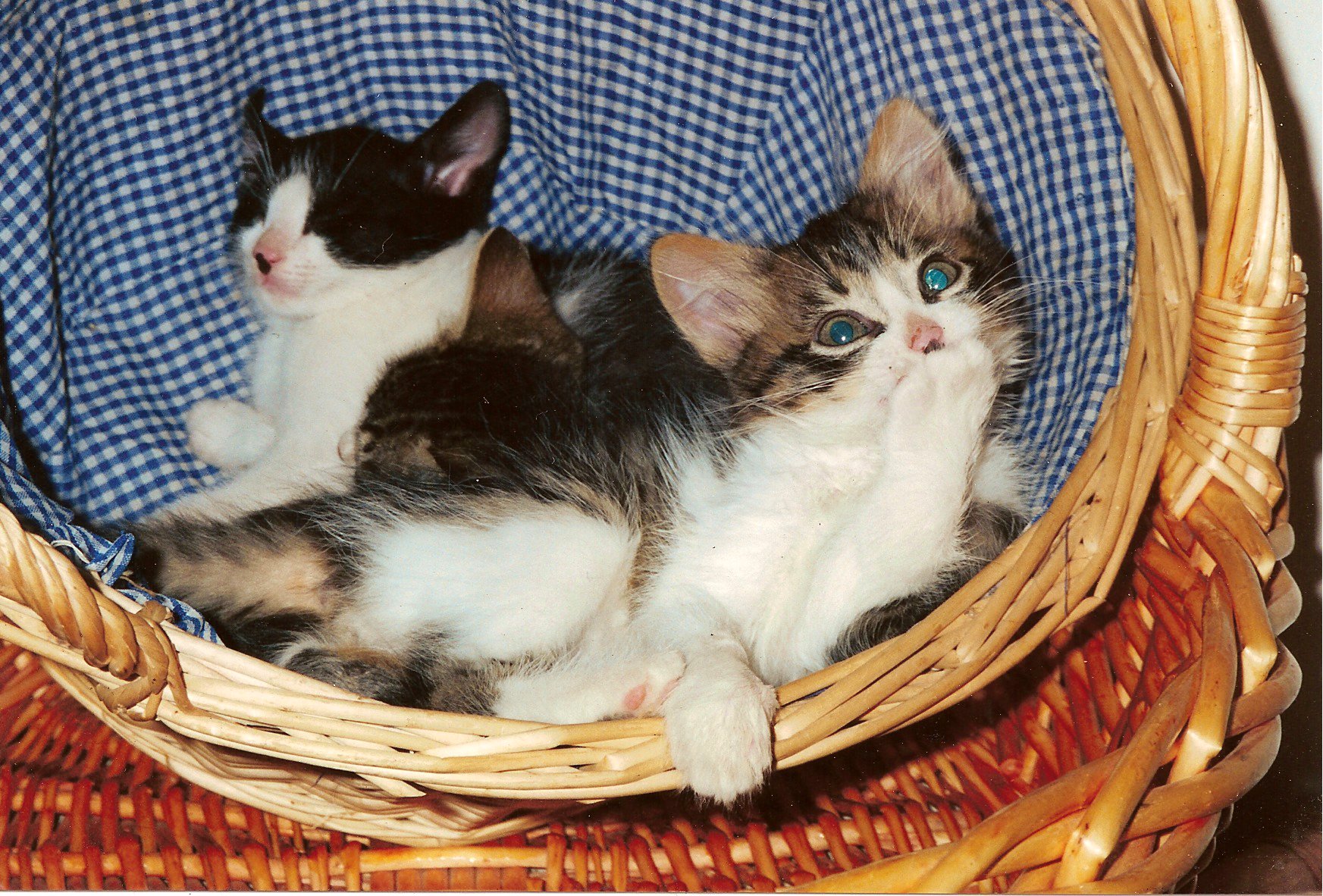
Three kittens in a basket and this was when they were already half grown!

While I fed baby milk in one end every couple of hours for the next few weeks, Holly took charge of cleaning the other ends, in a production line system. 

Balu was "the baby who would not be put down" and screamed his little head off if I tried to do so, so mostly I didn't. Thus, he spent most of his first few weeks sleeping in a makeshift hammock inside my t-shirt as I worked, took the dog for walks, etc. And, as soon as he was big enough to crawl up, he would crawl up the front of me, plonk a paw either side of my neck and reach up to "kiss" me on the lips. And he still did this almost every day of the 15 years of his life. 

As the kittens began to grow up, I could open the front door, in full knowledge that this big dog would carefully pick up stragglers and carry them back indoors again. Six years later and both Balu and his sister, Kitty (sadly, we lost the other brother, Khan, in November 2006), still came in to hide whenever "mummy" barked. And as soon as they were old enough, they would come for walks with the dog and I, like a line of little ducklings and it was so funny, when they started trying to bury "mummy's" poo pile that was almost as big as themselves! 

The day after we found the kittens, I learned that my friend Natalia (whose cats may have been their ancestors), had died at precisely 7 p.m. on May 3rd, 2001.

Nothing to see here, just a dog and her "adopted offspring" out on a walk.

Monday, 1 March 2021

Covid Vaccination and ME/CFS

On Thursday last (25 Feb 2021), I got my first dose of the Covid vaccination. My age put me in Group 7. My local GP had refused to place me in Group 6, despite sending them information based on the template letters from the ME Association, however, in the end I didn't press them on that after they'd revealed that, "Your Husband is recorded as being your Carer and so he will receive a Covid vaccination when we visit you." 

They were doing home visits earlier for housebound patients: I have previously informed them that I am mostly housebound and would have needed wheelchair and PA assistance otherwise to get to any appointment. So far, so good.

Background: Among a veritable Smörgåsbord of invisible illnesses, I developed ME/CFS after having Glandular Fever in 1973. Thought everyone was as knackered as me - until, after a number of other illnesses and events - I became very unwell in 1995, was rushed to hospital and never got better, settling usually at Moderate to Severe, on average at 80% impaired, on this Myalgic Encephalomyelitis Disability Scale. These days, I spend at least 23 hours a day lying or reclining in bed. Even sitting up is too tiring and causes my symptoms to exacerbate. Mostly, only travel as far as the bathroom. Going downstairs is like an excursion!

Anyway, I got a phone call on Wednesday that I initially ignored as it came from a Private Number (NHS what do you think you need to hide?), but thankfully they left a message so I called back. They said they could come the next day. 

So I've decided to also share my experience, not to discourage anyone - on the contrary, NONE of us is safe, until ALL of us are safe - so you can be prepared. 

Nurse came about 10 am on Thursday morning and I didn't even feel the jab. She warned that my arm might be sore in the area and made a point of asking which arm I wanted it in. About an hour afterwards my whole left side felt like it had been in the freezer, which was weird, but not terribly unpleasant. It was fine once I put on a second hoodie and had my lunch. I felt a bit sicky, slightly spaced out (more than normal) and had a fleeting headache, but those were soon gone. I was warned that I might feel fatigued, but I wasn't sure I'd notice. 

Before I went to bed that night I took a cold and flu relief oral solution - it's the only way I can partially tolerate Paracetamol. It still completely constipated me for two days, which did nothing to help! But I did sleep (unusually).

Friday morning I woke up unsure whether I was alive or dead. OK, hurting: must be alive. With Myalgic encephalomyelitis/chronic fatigue syndrome (ME/CFS) I'm used to my body overreacting to medications, but this was extreme.

First thing on Friday morning I was so cold and my hands and feet were so cold it took 3 hours under extra covers, with two cats, two hoodies and with a heated blanket on full to even begin to warm up. Then I felt like I had a fever. 

I ache all over all the time, but this took it to the extreme like sports strains. My legs felt like they had polio and couldn't even get to the toilet without help.

And the migraine-type headache was so bad I couldn't even open my eyes to or lift my head off the pillow without feeling sick and dizzy. I couldn't even bear to watch moving pictures on TV. For 36+ hours all I could do was keep waking up to pee, drink more water, then drift back off to sleep again, rinse, repeat.

I've even had to lie flat after drinking plain water to prevent me bringing it back up again, because it made me retch, but I needed to drink because my pee was hot. Cleaning my teeth, the toothpaste made me retch. Can't even face tea. The only thing I was able to eat Friday was a bit of dry toast - I don't normally eat bread, but it was the only plain thing we had in the house that I felt I could stomach. A small, sugary treat just tasted sickly and made me nauseas and I immediately started to get a headache, like a sugar rush headache or hangover - not fun! I still can't eat and drink normal food and my stomach is in knots. 

Sunday morning had my first shower in days and had to lie down afterwards because it made me feel ill. The soreness from the jab in my arm is still off the scale and I can't lie on it even now. On Friday, I couldn't even use that arm.

Some of these are my normal symptoms of ME and the jab has just caused a huge crash. Everyone reacts differently, so hopefully none of this will apply to you, but at least you can be prepared so you can be as comfortable as possible. Gather things together in advance like extra blankets and bedsocks - apparently the cold thing is common, as are the aches and the sore arm - medication (if tolerated), bottles of water, plain foods you don't need to prepare ... 

A couple of day's roller coaster, compared to being dead from the virus? My hope is the reaction will be milder when I do this again in mid-May. (It was.)

PS: I'm still waiting for Bill Gates to get in touch and I haven't noticed any improvement in my mobile signal, so I think we can discount those. 😁 

Monday, 1 January 2018

Testing for Orthostatic Intolerance

Way back in 2009, after I'd begun heart rate monitoring (my initial readings can be found here: Compared to the normal ranges for my age, I'm dead ... and recent monitoring has confirmed this to still be the case, in fact the readings were generally even lower), I followed it up by doing Dr. Bell’s Simple Test for Orthostatic Intolerance, which I'd first read about on Sue Jackson's post on Orthostatic Intolerance and CFS.

However, I never managed to write up the results, so here they are. As recommended, I began the test late morning, ~2 hours after breakfast. Before starting, I'd merely been to the loo and back, hardly an "unusual activity!"

Interval SYS DIA Pulse Observations
Outset 91 60 78 Normal after mild activity.
5 minutes lying flat 111 62 54 Typical resting figures.
10 minutes lying flat 92 63 51 Ditto.
5 minutes standing ? ? ? Unable to stand still - swaying uncontrollably. After less than 2 minutes, twinges in ankles, feeling of swelling, assumed to be blood pooling. After 3 minutes began to get lightheaded and nauseous.
10 minutes standing 128 100 60 Shortly into round 2, began to get a headache, nausea becoming worse, extremely hot, sweating, trembling.
15 minutes standing 109 74 80 Other symptoms continue to build, plus lower back pain started, legs ache, urge to march on spot. Feet appear red and mottled.
20 minutes standing 97 60 73 Pain in ankles, shins and calves worse again, pain in hip close to unbearable, nausea and trembling both up another notch. Trying to control thinking in increasing brain fog becoming difficult. Dry mouth.
25 minutes standing 110 62 72 All symptoms still increasing, but ability to articulate ceased.
30 minutes standing 99 74 85 Ditto.

If we go by the numbers, then I think the results of this test are inconclusive.

Certainly the trend in my pulse rate appears to coincide with what would be expected in a patient with orthostatic intolerance and the final pulse reading of 85 is still more than the tolerable 28-30 rise from the resting pulse of 51.

Although there is nothing in the real danger zone, it's not difficult to see that, once I begin activity and not just standing on the spot, however cautiously, I am bound to go into the "exhaustion zone." Even if I keep within my limits while doing light activity at home, the moment I need to exert myself by having a shower, or walking, I just get caught in the vicious cycle of 'push and crash'.

The blood pressure readings are all within what look to me to be the tolerable side of low. What I don't understand is why they went up and down erratically and at times up, when the expected result would be down. My hunch, based on how I felt, is that my blood pressure rose in direct relation to the onset or notable increases in symptoms of pain, hot flushes and overall discomfort.

Frankly, I was more than surprised that I managed to get through the 30 minutes of the standing test without becoming so lightheaded as to be unable to remain upright, because this has happened before, inside a minute. That said, I know I was only able to push beyond what I'd normally be able to tolerate, mostly because I was doing nothing else that day and was in the relative comfort and safety of my bedroom, i.e. I knew I could lie down if it got too much and that I could - and did - lie down for most of the rest of the day to recover.

If I'd attempted to stand for a few minutes, say in a work environment, I wouldn't have been able to do anything else while doing so, nor for the rest of the day. Even if I'd only been out shopping, I'd have found the symptoms intolerable and would have needed help, or to sit down (as I have on many a shop's floor).

As soon as I finished the test, I did have to lie down and continued to have a headache and nausea, while the trembling, which is my usual response to any over-exertion, was still continuing to increase even several hours later.

The next time I got up to go to the kitchen, after a short rest, I felt achy, battered and bruised and, as soon as I was upright, the nausea and trembling increased again. The second time I stirred, although I didn't lose consciousness, I couldn't focus, nor keep my balance and was bumping into walls.

Later in the day, as often occurs after exertion, I suffered a nose bleed.

The pain in my back, hip and legs, lasted the next few days. Nine years on, my symptoms come on quicker than they did in 2009. My tolerance for standing has decreased and rather than push myself into flares of symptoms that would put me in bed for a week or longer, I now have help to do all of the things I struggle with, including wheelchair assistance whenever I'd need to stand or queue.

Friday, 20 March 2015

Welcome to Medieval Britain

It’s clear that the current government has been doing it’s worst to take Britain backwards to pre-1948 (i.e. pre Welfare State.) Others have suggested that they’ve taken us back to the Victorian era and that’s certainly true with regard to their renewed keenness to lay the blame for poverty and unemployment upon the 'idleness' of the individuals concerned. Their ideological standpoint certainly is that regressive, because by the 1940’s that attitude - the attitudes of politicians and the public towards social welfare - had changed dramatically. 

For it to have returned to the hideously cruel and backward ideas of the Victorian era … I have no words. Oh, actually I do. Three: Evil. Greedy. Bastards.

Meanwhile, it dawned on me that the regression is going WAY further back.

Whilst researching something totally unrelated (as you do), I came across this explanation of life in the middle ages, The Manorial System & Common People. Common people. Yes, that’s us! We’re still viewed with the same distrust, disrespect and disgust. Not because of anything we’ve done, but because they judge us in reference to their own standards of behaviour. Still.

Anyway, as an example:
“A serf's job was whatever the noble told them it was, carpenter, blacksmith, baker, farmer, and tax collector, serfs did it all. A serf could buy their own freedom if they could get the money, but where could they get the money?”
Doesn’t that sound familiar, when you compare it to anyone with a low-paid job these days, anyone on zero-hours contracts, forced onto workfare … and no way out except overpriced payday loans? You can read more here. Oh, and it’s for kids, so it should be simple enough to understand, even for right-wingers.

Thursday, 19 February 2015

The devil in the details

A comment in an exchange on a ME forum on Facebook attracted my interest. They said:
"My biggest issue is finding caregivers who really understand how important it is to be detail oriented to save me energy, like making sure to put things away in the right place so I don't waste energy having to search for it. But I have found a really good caregiver and she really does understand. She has two other clients, who are both paraplegic and she says if she had to choose, she would rather have their disability than mine, because their quality of life is so much better."
Sadly, most of us with ME will identify with the quality of life issue. 

It has often struck me (and this is a bit of an elephant in the room, because it could seem very insensitive to say so), but that "merely" having a physical disability, whilst otherwise feeling quite well, is bound to result in a better quality of life than for those of us who have to deal with a long list of physical and neurological limitations, mobility issues and chronic pain, as well as feeling incredibly unwell, day-in-day-out, but that is so often not considered.

On a practical level though, the rest of the comment is excellent food for thought. There's really not much can be done about whole days lost looking for the item you put in the daftest place yourself, because of brain fog (did that one yesterday), but clearly a lot to be gained from organisation; having a system and a place for everything. That goes hand-in-hand with pacing. 

And having had carers, I can confirm that with up to three visits per day, from the same number of different carers, then the most frustrating thing is all the time and energy one spends trying to find the things that they have all put back in different places every time. There were times when both I and my husband were on the brink of saying that this one thing cancelled out any of the benefits.

Frequently, I feel that my list making and organising gets to obsession level: that someone who can scarcely manage to get out of bed, let alone out of the house (rarely for ever shorter periods) really shouldn't need organisation at the level applicable to large and complicated projects, but I seem to. It helps me to remember things, get something done in small, manageable amounts.

Even my (supportive and understanding) husband doesn't always get why it's vital for me to keep on top of things and why I persist in trying to manage to do so, when even I know that I really need to rest and NOW. So, yes, I can also see why it is going to be difficult to get caregivers to fully grasp this need. 

But not doing things and the consequences thereof of chaos, mess and clutter (those being relative terms) are, in fact, much worse than continuing to try to keep things under control, even at a cost to current energy and the resultant post-exertional malaise. The later cost of catching up, along with additional stress of the interim nagging anxiety, would add up to so much more. I'd like it not to cost at all, but I haven't found the solution to that conundrum yet.

The natural progression from having everything in the right place so you don't have to search for it, which I discovered by bitter experience yesterday when searching for that misplaced item, is not having too much clutter through which to search. Dealing with clutter not only creates physical challenges, but it really bothers me mentally and I can now see why it will be critically important for my health, in both ways, to get this dealt with. Decluttering has to be one of my next projects to organise. Probably in painstaking, obsessive detail. <Evil grin

Monday, 28 April 2014

Breast cancer mammograms: overrated, overhyped and over-diagnosing, compounded by evidence of harm

Is it time to radically re-think the flawed philosophy behind the 'early detection' tenet of the breast cancer awareness movement? They go against the Hippocratic Oath (they do harm)! At last somebody else is saying it. It's why I've been refusing mammograms (and NOT supporting pink-ribbon "awareness" campaigns) for years; that and the pain of them (unbearable pain when you have fibromyalgia) and having had a false positive diagnosis of breast cancer myself back in the 1990's, with all the accompanying stress that brought. 

It is impossible to adequately describe how that diagnosis affected me, severely compounded by the fact that it was delivered with a total lack of tact and compassion, publicly in the busy corridor of a Spanish hospital, but I 'lost' several days where I could not function, could not speak, could not think, could not sleep, could not eat ... I was alone and it was enough to cause PTSD.

Yes, undoubtedly, this is not as bad as actually having cancer, but there was no way for me to know that at the time and, by then the harm was done.
"In calculating the role of population-based screening, the absence of benefit is only compounded by evidence of harm: 21.9% of breast cancers found through mammography screening represented over-diagnosis, according to the Swiss Medical Board. This means that one in five women who was told she had breast cancer after mammography screening received unnecessary treatment."
It's lucky I was sceptical and rejected the (barbaric) treatment offered me as the only option, or the end of this tale might have been very much worse indeed.

Breast cancer mammograms: overrated – and over-diagnosing women

Tuesday, 15 April 2014

What is 'disabled enough' for some people?


What is it that makes some people think that they're entitled to their ill-informed opinions, which, when voiced, are clearly a cause of abuse and harm? This is something that happened to me, when another attendee at a yoga class - I would mention this was a gentle yoga class aimed at old folk and those of us with chronic conditions - saw that I'd parked in a nearby disabled space. She told me - in that haughty tone that people like her use - that I was 'not disabled enough'. When I told her I have a Blue Badge, she more or less accused me of fraud.

(Let's not even mention the "Have you tried yoga?" brigade. They can STFU! Isn't it enough I was pushing myself to try this in the first place? Shouldn't have.)

Anyway, knowing she would be likely to gossip to others in the group and slander me, I decided to write an open letter and hopefully nip it in the bud. At least make it clear to her that I was not about to let it go. This is what I wrote: 
You probably won’t realise just how upsetting your words were last week, but I was so upset I was unable to formulate a proper response at the time and instead went home flattened and emotionally spent. What I want you to know is that it’s precisely because I have a Blue Badge - and because my husband is able to provide me with a car - that I seem to be able to do things. It is only because I have these things that I now have some independence. I’m still only able to do something for a couple of hours on one or two days a week.

You certainly have seen on various occasions when I have had to sit out during yoga because I’m feeling too dizzy or unwell to continue. 

The whole point of coming to yoga is to try to help some of my symptoms and it is imperative that I am able do this in a friendly, non-judgemental environment. 

But you don’t see me for the other 166+ hours per week, most of which I have to spend either in bed or reclining on the sofa because I am too ill or exhausted to do anything else. 

This is profound, unrelenting, medical fatigue and weakness - not just feeling a bit tired - that means I may appear able to do things, but even when I can do them, I can usually only do them once before being exhausted. You can’t see that even the minor effort of walking a few yards causes me to feel exhausted, sick and dizzy. You can’t see my symptoms, but that does not mean they are not there or that I’m entirely able and not in need of help. In fact, it takes countless aids and adaptions for me to be able to have anything vaguely approaching a normal life – which is the whole point of these assistance aids.

You also weren’t there when I was diagnosed by GPs, rheumatologist, the pain clinic, the ME Clinic, or with those who carried out the assessments for my benefits and Blue Badge … 

You haven’t had to live with my chronic illnesses – and learned that pacing to avoid doing too much so I don’t exacerbate my symptoms is the only “treatment” available – for 41 years, since I was 16.  
Some days, I can’t do anything at all. Nobody sees me on those days.

So when you suggest that I am ‘not disabled enough’ to have a Blue Badge, or that the system is wrong for me to be able to get one, please consider these facts, along with the knowledge that I’ve crawled my way up from previously being constantly bed-bound to being able to do what I can today, precisely because I have help like a Blue Badge, but I could easily find myself back in that position if I did not. 
Maybe that would be disabled enough for you? 
(NB: I've since deteriorated, no longer drive and don't go out alone.)

Saturday, 20 October 2012

The Neighbours from Hell

Not their cat, but they did have one that was a right bastard!

These individuals have been carrying out a campaign of harassment against me for the past 4 years. There was the time the wife attacked and slandered me in the street in 2008 and then, in 2009, when the husband even threatened to hit me. All because they have believed my mother's lies about me. Anyone with any intelligence at all would consider both sides before making judgments. Anyone with any class wouldn't behave in such a manner, ever. And you'd have hoped that things would have improved since mother died last year, but they haven't. 

Several witnesses could assure you that this harassment is all one-sided and that I've done no more than ignore them. They're heavy drinkers and the police are now aware of their behaviour. It was on the last occasion when I was obliged to call 999 because of their behaviour towards me that they were visited by the police, whom I know to have advised them that, 'if they felt they had any complaint, they should make it through the correct channels'. 

Hence, they contacted the council who wrote to me about their complaints in Aug 2012. They should have specified "valid" complaint, obvs!

Among the frivolous complaints these harassers brought were accusing me of playing loud music, when it was, in fact, themselves. Yes, really! On one occasion they began complaining to another neighbour about “my” loud music and this neighbour was able to tell them that she had heard the complainant shouting above her own music, asking her husband what to play next. It's laughable.

On another occasion, on a Wednesday afternoon, I did play some music while cleaning the house and at 5:25 p.m. (hardly 'unsociable' hours) hear this idiot shout out, “Turn it down for Christ's sake.” To begin with, it should be obvious that, if I could hear him, over the music, inside my house, it can't have been that loud. In fact, I measured it and the reading was in the region of 60dB, which is described as “normal conversation at 3ft.” Utterly unreasonable.

Next they complained about dog barking. On several occasions, it has been reported to me by other neighbours that they were complaining about “my” dog barking, at times when I know that my dog was under my bed sleeping and these others confirmed it was barking was from other neighbourhood dogs.

They also listed screaming and shouting. What, at myself? Mere fantasy.

I'd already paid for additional soundproofing (above that stipulated by Building Control) to be installed on our only adjoining wall, because I knew they were likely to be assholes. I cannot hear any sounds whatsoever coming from their property, so I am confident they cannot hear sounds from mine either.

They're absolutely obviously making it all up.

Of course, I invited the council to carry out whatever monitoring they wanted, but funnily enough, they didn't accept the invitation. I'm sure they could tell.

The harassers also objected to my works on refurbishing my property, as if they had a right to that and I was not entitled to modernise the unmaintained sh*t hole my mother left. They'd even climbed up on ladders to look over the six-foot fence and take photos of my builder's equipment in my garden, because they imagined they had a right to complain to the council about that too! 

To add to this, my builder told me that the woman had accosted him in the street while he was on a break to tell him that I was evil and had killed my mother

Fortunately, he was intelligent enough to see through this and was both astounded on my behalf and amused in equal measure. But it could have been much worse, if say, he'd listened and maybe walked off the job as a result.

This campaign was in addition to them trolling me online that obliged me to close, remove or move sites, social media and content to deter the bullying.

Others, including my mother, told me that the neighbour in question had a gun in his possession, which was related to his work on a country estate. This I've only had reported to me, however, I have been told that, on a tipoff, the police called to their house next door one evening. They found the said gun, lying loose and unsecured, on their dining-room table, surrounded by a quantity of ammunition, all of which were confiscated. Put this together with the above unreasonable behaviour and I do believe there was a real potential threat to my life.

Saturday, 31 December 2011

Analysis of an ME symptom diary

I never travel without my diary. One should always have something sensational to read in the train.” ― Oscar Wilde

This 2011 symptom diary definitely doesn't qualify as sensational and even bores me. It was never intended for publication in the first place, but it has been a very useful process to type it up and analyse in retrospect. That process has allowed me to identify trends, like what activities cause what symptom or payback, which is enabling me to plan what to avoid to keep symptoms bearable. 

Reading it back it's just a tedious and repetitive round of constipation followed by IBS; activity, followed by excruciating pain, lack of sleep and worsening post-exertional malaise (PEM). But, boring as it is, I'm sharing my experience in case it can be of use, from the process, or something that perhaps resonates. 

It sounds so easy to say avoid such boom and bust cycles and learn pacing. Quite another to achieve that in reality when, often, too much activity (that will cause unforeseen symptoms) is merely getting to the bathroom and back. It took many years and writing all this down and reading it back for the penny to fully drop for me, so I do understand why it's hard for anyone not actually experiencing it to grasp, but I do think a few more could at least try to have some empathy.

The biggest conundrum is if I wake up just tired, but only feel averagely crap. But this is the worst time, because when you finally get it right and reduce your stressors to the required level to not provoke unbearable symptoms, 'imposter syndrome' clicks in (undoubtedly worse due to medical gaslighting), we begin to think maybe we aren't that ill after all, then overdo it and go right back to the start all over again. Going through this process means I do that less now.

Anyway, here's what I've learned from analysing my 2011 Symptom Diary:

  • My sleep pattern has it's own mind. Doctors and other health professionals bleat on about sleep hygiene like it's some universal panacea. It. Does. Not. Work. (There isn't really any evidence that it works either.) In my case, I sleep better with some low light and some noise (TV, white noise ...) and can't stand dark and quiet - I mean, to the point that it is mentally disturbing and nightmare inducing. And sometimes even that doesn't work. The only thing I can somewhat control, is to make sure that I don't do things on days where I haven't had enough sleep and am thus wired, strung out and already knackered. Easier said than done, because, in practice, that means avoiding making any plans. And pleasurable, non-essential ones are the first to go. During 2011, I had far too many medical and counselling appointments that, in retrospect, were often of little value, but which caused massive amounts of post-exertional malaise (PEM), with severity in inverse proportion to the amount of sleep. So, I guess the take-away here is to learn to say NO. Even to doctors and especially to other 'well-meaning' people. Accept and trust your body on this.
  • Outings cause pain that prevents me sleeping as the pain in my legs often keeps me awake all night. Well, any activity causes pain and overactivation, which then causes lack of sleep, which causes the pattern to repeat. Walking any distance provokes this, yet I persevered for years because a) I had no alternative means of transport and b) under the misapprehension, based on 'expert' opinion that it would do me good. It certainly did not. All it did was keep reducing my baseline and what I could achieve, from which I have never recovered.
  • Low light may be good. Light early mornings on the other hand are dreadful. Maybe this intolerance is more pronounced for me because I spent 16 years closer to the equator, in Tenerife, where there is a lot less difference in the length of day between summer and winter, but these seasonal swings in the UK are something I cannot seem to adapt to and which increase my lack of sleep in summer, which increases my symptoms and reduces my baseline. Even more.
  • Any effort causes exhaustion symptoms such as breathlessness, shaking and feeling uncontrollably sick at the time and later post-exertional malaise (PEM) symptoms, which are flu-like with sore throat, swollen glands, feverishness, headache ... The only fluctuation is the amount of said effort that will cause this reaction cycle to start. Predicting or noticing what that point is, is the hard part, because it's a full-time job that requires attention, awareness and concentration that are, in themselves, activities that can cause exhaustion and payback. 
  • Travelling to anywhere is exhausting, but not all methods of transportation are equal. It's not necessarily logical, but walking is not always the worst - or most exhausting - means if an alternative, like the bus, would involve lots of waiting and standing around that causes worse symptoms and greater excruciating pain. Buses, I've found, are impossible anyway because of the jolting. Trains are only acceptable if a seat is guaranteed. Car journeys are intolerable if they're too long, require me sit too upright or over poor road surfaces. 
  • My system gives me no warning of IBS-like attacks, however, by analysing the diary, I can see that the majority of them tend to follow episodes of constipation. It isn't stress that's causing it, it's mostly medication, especially pain relief, or changes to my diet that are the worst culprits. Oh and THE WORST thing: Buscopan - prescribed by the GP for IBS. Irony at it's most surreal. Let me make the distinction here: I'm calling these 'IBS-like attacks' because there is overlap and they are just like IBS symptoms. GPs have diagnosed me with IBS twice, probably wrongly. What I think is the case is that these are gastric symptoms due to myalgic encephalomyelitis. That also means that a drug like Buscopan that is designed to stop the sort of stomach cramps that you'd get if you had, say, a stress-induced tendency to IBS, will, in someone with an already exhausted system - and this is my experience with it - simply cause the bowel to become virtually paralysed and unable to function. Then it 'backs up' causes constipation, even more headaches, nausea, until it 'explodes' again. The only things I can do to avoid this boom and bust cycle is to absolutely never take pain relief, not even a Paracetamol, never take Buscopan, avoid binding foods like eggs and never deviate from a roughage-heavy diet.
  • Of course, 'absolutely never taking pain relief', means the only method I have left for avoiding pain is to avoid all those activities or environments that would provoke or increase pain. 
  • Ah 2011 was also the year I learned that I cannot tolerate a dental anaesthetic, which contained adrenaline. The hard way. Since then I have insisted a warning goes on the top of my notes. If a new dentist did not want to understand this, I left and changed dentist. 
  • A HUGE reason for keeping the diary in 2011 was because of the abuse and bullying I was receiving from my mother and certain people she had manipulated into continuing this for her. Being threatened with violence, verbally attacked and slandered were among the reasons I sought support and counselling, because I'd been pushed to the point of breakdown. She died in 2011, which, for me, began a process of recovery, from that at least. Every cloud, as they say.

Thursday, 8 December 2011

Funerary Fiascos

My mother managed to put the 'fun' back into funeral.

For the record and the sake of my sanity, I will detail the fiasco of my mother's funeral while it is all still reasonably fresh in my mind. When my mother died in Sep 2011, I knew that her funeral was all pre-arranged, because when my father's mother had died back in 1993, my father had bought outright two pre-paid funeral plans - for himself and my mother - from the proceeds of the sale of my grandmother's house. My father trusted and liaised with me on these things, so I knew about them. As he named me executor and I'd had a significant role in arranging my father's funeral, I already had experience of the procedure. 

Of course, as my mother had made a - successful - career out of convincing people that I'm entirely stupid, lazy and a liar, I was judged incapable of being able to handle this. My mother was admitted to hospital in August with a virus - obviously a risk in addition to the Chronic lymphocytic leukemia she was having chemotherapy treatment for - but it was the fact that she was subsequently pumped full of IV antibiotics by the hospital that probably finished her off. 

This is something I can say confidently, because antibiotics are absolutely not indicated for viral infections and, in addition to the chemo (the chemo she denied having) depleted her immune system - it's in writing on her death certificate. So I queried the antibiotic use with the hospital doctor. Pretty sure it was as a result of my raising this issue that, despite the fact it wouldn't normally be done when she was already in hospital, they involved the coroner. To me, that means they knew they'd done wrong and were perhaps expecting a complaint. 

But despite the relationship we had, I compassionately kept up her pretence that she might get better. It's what you do if you're a decent human being.

On the other hand, a so-called [now former] family friend visited this frail, dying, old woman in hospital and outright asked her if she had organised her funeral

How do I know this? Because the idiot came straight round to the house to 'proudly' announce exactly what he'd just done, clearly with the impression that I couldn't know what was already organised nor be able to carry out those plans. He's not related and at no point ever was he going to be responsible for this. Seriously, I could not believe what he was saying and that he had been callous and insensitive enough to ask my mother such a question. I was and am, horrified and incandescent with rage and sent him away to never darken my door again. 

(Why was he even in the area? TBH, I've always suspected hoping to inherit.)

Very deliberately, because of this unforgivable behaviour, I did not invite him to the funeral, but he just gate-crashed it anyway, along with his wife and other uninvited parties. He also contacted me again afterwards, claiming that certain things I did - like where her ashes were scattered - was not what my mother wanted. It was what was pre-arranged. It's possible my mother could have had one of her hairbrained ideas (that wouldn't have been allowed anyway) that she'd mentioned to him, but remember, I had the funeral plan in writing. If she'd changed her mind since those 1993 plans had been written, she had not told me, neither had she had the plans amended or changed and it was not up to me to make any changes to them based upon any "hearsay". So I didn't. As sole executor, I was the only person officially, legally, responsible for that decision. He kept ringing and I blocked him in the end. He could f*ck right off. I've had no further contact, but I'll bet he hasn't worked it out and still thinks I'm in the wrong.

Even so, I was surprised at the detail in the funeral plan in writing. The only item not included in the price was the person to conduct the funeral. So I chose a non-religious celebrant and everyone was very complimentary about it. Obviously, I wrote what the celebrant delivered - I don't think anyone considered that I had, or it would have been criticised, I have no doubt - and I will say that he did deliver it beautifully, naturally, as though he actually knew the person he was talking about. We also included music from my mother's own collection.

The only other item I had to chose was the colour of shroud. So I asked if they had one in beige. Of course I was being sarcastic, but she loved beige.

The funeral plan also included both the hearse and a limo. Because of issues with neighbours (the ones who threatened and slandered me, who I didn't want turning up at the funeral, nor coming out to heap yet more abuse at a cortege), I chose not to have the hearse come to the house, but to meet us at the cemetery. 

All through her life my mother had been utterly incapable of being ready on time. So much so that, if they were going out somewhere, my father would tell her to be ready half an hour earlier than needed. He knew it was the only way she would ever even approach punctuality. So, we got to the cemetery in the limo and had to wait for the hearse. Yep, she was late for her own funeral.

At which point I disolved into fits of giggles. As you do. Couldn't help it.

For the same reason of not wanting abusive, disrespecting people at the house, I did not arrange a wake and didn't want to be at home in case anyone turned up expecting one, so I and a couple of friends went down the pub and raised a glass. If my mother had been there, I'm sure she'd have been happy with that.

On the morning of the funeral, additionally, it became clear that a group of mother's work colleagues thought the “no flowers” request I'd communicated was my choice, and therefore they were going to totally disregard it. Why would they do that, unless they'd been 'trained' by her to disbelieve and disregard me? Would they have disregarded a similar request from anyone else's family? Absolutely not. It was only once I'd pointed out that this was my mother's wish – which could be confirmed by her similar request for no flowers at my father's funeral that they had helped out on – they finally seemed prepared to believe what I'd said. 

For the record, after living in Spain for 16 years, where the norm at funerals is for masses of huge floral tributes, if I were to have imposed my preference, it would have been to have had as many bright and cheerful flowers as possible to lift the spirits of the day. But it wasn't about me and, despite our history, I actually did everything my mother had wanted and followed her plans to the letter.

The flowers I had placed on the coffin should have been the only ones, according to her wishes, and mine were a very deliberate choice of the nearest to the roses that she'd had in her bridal bouquet. It was what she had chosen for my father's funeral too and were most significant to her, which she had often mentioned. It was also deliberate that I left them as just a simple, un-arranged spray. My mother's flower arranging and floristry work was outstanding, so I was not about to insult her by giving her someone else's, inevitably inferiorly, arranged flowers. But there were lots of arranged flowers for her at the cemetery, so lots of people had ignored the request after all - my mother wanted donations to go to Cancer Research instead, just as she had asked for, and got, for my father's funeral - but because of the lies she had spread about me, people disregarded her wishes. Thus, she was, deservedly, hoisted by her own petard in the end.